

Working with single-minded purpose over a span of ten tempestuous years, 1849 – 1859 — his so-called Middle Period — Giuseppe Verdi, impatient genius, musical visionary, artistic freedom fighter frequently opposed by state-sponsored censors and the Church, essentially invented Giacomo Puccini and, by way of prior example, Italian Grand Opera.
Luisa Miller, Rigoletto, Il trovatore, La traviata, Simon Boccanegra, Un ballo in maschera — an unprecedented succession of explosive operatic triumphs, the vast majority instant classics, confirmed Verdi’s reputation as a master of reform. Compelling narrative and sharp characterization supported by highly reflective compositional design and orchestration assumed vastly heightened levels of creative importance.
Opera surged forward sweeping Verdi into the Romantic Age. The past, however, still clung to him. The sudden death of his cherished wife and two small children, struck down by encephalitis shockingly early in his life, forever darkened his vision. The theme of love and loss as seen with particular shattering clarity through the lens of abiding familial relationships recurs throughout Verdi’s work, arguably nowhere more insistently or to greater dramatic effect than in Rigoletto.
The twisted tale of a tormented father, caustic hunchbacked fool to a lecherous count, and his manic determination to preserve his innocent daughter from harm, for all its blistering condemnation of immorality and corruption bred by amoral establishment pawns is, at heart, a domestic tragedy. The emotionally scarred jester, his wife long since perished. Gilda, the over-protected child-woman, raised single-handedly, ill-equipped to survive in an evil world. Grief. Guilt. Heartbeak. Everything else serves as backdrop. Homespun harmony and happiness are an empty fantasy.
With its sprawling revival of Christopher Alden’s subversive Rigoletto, first presented amid abundant cries of disdain from patrons and critics alike at Chicago Lyric Opera in 2000, the Canadian Opera Company opens its current winter season on a conspicuously anachronistic note. Revived in 2011 by the COC, remounted in 2018, the controversial, New York City-born director’s 2026 iteration feels vastly less resonant than last encountered.
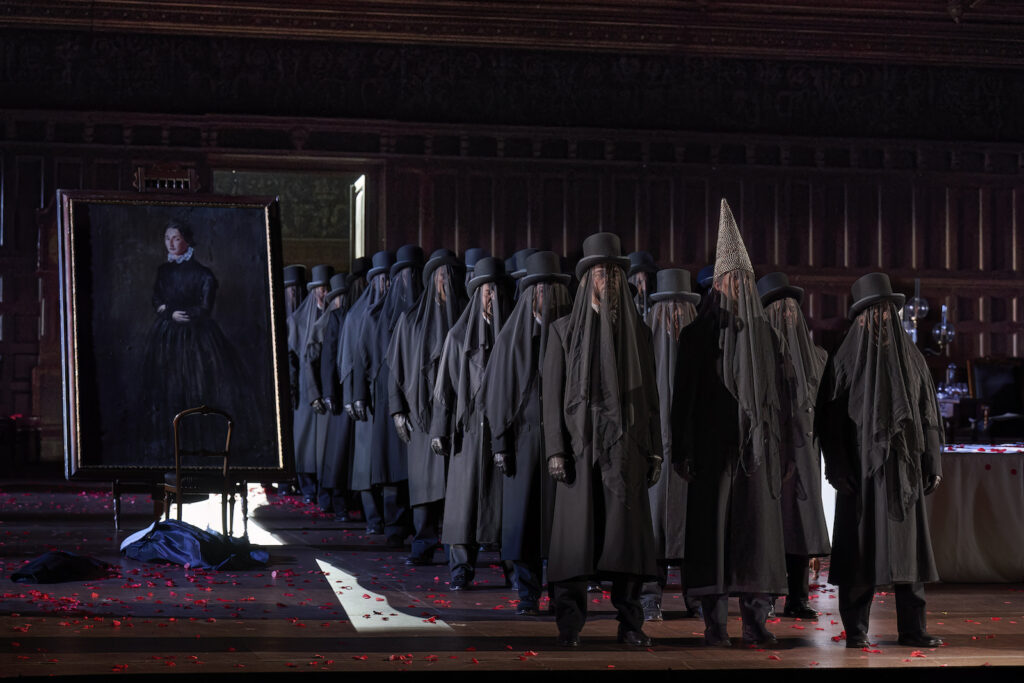
Cued by the #MeToo movement virtually as it crested, Alden’s violent, densely atmospheric social manifesto left a vivid impression a decade ago, Set Designer Michael Levine’s striking Victorian gentlemen’s club — all expansive coffered ceiling, and genteel overstuffed leather chairs — a dark-panelled bastion of male privilege. What seemed charged with theatrical immediacy then radiates little more than a lingering sense of historicity now in this, the egregious Age of Trumpism. Morality is mutable it would appear. Little to nothing shocks us today.
The passage of time and, with it, a diminishing of operatic urgency is, however, the least of this faltering Rigoletto’s problems.
Confining the action to a ubiquitous one-note monoset, however grandiose, still provokes a good deal of confusion. Compounded by Levine’s frustratingly anonymous costume design — basic masculine-suited noir, unremarkable bustled feminine ballgowns — questions related to identity and stage geography inevitably arise. Who is who, where and why?
A lingering sense of displacement clings to Alden’s tumbled scena. Seated alone in a stiff armchair before a silky curtain, Verdi’s menacing overture engulfing him, Rigoletto first appears, brooding and deeply troubled, less persona dramatis, more manifestation of directorial concept. All that follows, Alden clearly suggests, is rooted in the ill-fated jester’s mind, haunted recollections on eternal repeat, traumatic exclamation marks on his darkly hyperactive subconscious.
Time and place dissolve, one into the other. Reason vanishes. Librettist Francesco Maria Piave’s carefully constructed story arc built on methodical, increasingly tense narrative beats threatens to collapse under the weight of Alden’s heavy-handed conceits.
A full length portrait, invisible to courtiers, of a dignified, self-contained woman — Rigoletto’s much adored wife we are led to understand early in the proceedings — stands watch in the middle of the Duke of Mantua’s club/palace, reappearing slashed and toppled in Act II. Ah! Presso al patibolo bisogna ben l’altare! Ma tutto ora scompare! L’altar si rovesciò! (“Ah! Next to the gallows there must indeed be an altar! But all now disappears! The altar has been overturned!”) Literally.
Gilda mounts an impossibly long ladder, a celestial deus ex machina escape route perhaps — nothing is certain in Aldenworld — in a desperate attempt to flee a pack of rabid nobles intent on kidnapping her. Angels are frequently referenced by Rigoletto when describing his heaven-sent daughter.
The rumble of distant thunder, more psychological distress made audible than approaching storm, accompanies Rigoletto as he treads a precarious path of murderous revenge, Alden’s blunt Act III pantomime conveying the impression of metaphor brought to life on the narrow, harshly spotlit apron of the Four Season’s Centre deathly quiet stage.
There is something fundamentally precious, disturbingly inauthentic, about Alden’s auteur-driven approach to Rigoletto. Surely there is vastly more than sufficient demonstrable horror implicit in Piave’s searing text, more anguish and pain in Verdi’s heartfelt music than contained in over two hours of awkward, expressly artificial theatrics.
Singers and orchestra largely prove the point.
Appearing in the taxing title role, Met Opera star Quinn Kelsey contributes a powerful, unencumbered rendering of the poignant hunchback, frantic father all but crippled by remorse, desperate, traumatized, his spectacularly luminous baritone a cry, a shout, a roar into the darkness. Pari siamo (“We are equals”), rages the bitter Rigoletto, Kelsey launching Verdi’s great towering aria into the realm of the heroic. A virtual masterclass in dramatic encapsulation and uncompromising expression.
American singer actor Ben Bliss is a thoroughly credible Duke of Mantua, slippery, sly, wickedly handsome. While endowed with a somewhat earthy timbre — a stark contrast to the rather more traditional ringing, bell-like Italianate tone often associated with the role — Bliss breezily sets the three mighty cornerstones of Rigoletto’s tenor architecture firmly in place. The rollicking cabaletta Questa o quella (“This woman or that one”), a respectful salute to bel canto on Verdi’s part. The irresistibly wicked canzone, La donna è mobile (“Woman is fickle”) and the beautiful, if decidedly louche, Bella figlia dell’amore, a soaring four-part quartet, Bliss firmly in command of melody.
Following in the wake of her much acclaimed double West Coast appearances in Rigoletto in the spring and fall of 2025, appearing at both Pacific Opera and Vancouver Opera respectively, rising young soprano headliner Sarah Dufresne sings a sparkling, positively refreshing Gilda, limpid and shining and utterly devoid of affectation. Gifting the evening with an exquisite Caro nome (“Dear name”), Dufresne utterly triumphs, her voice an almost organic extension of Verdi’s ravishing harmonies, coloratura trippingly playful, the ever inventive maestro’s extraordinary cadenza — 55 seconds of pure unaccompanied excitement and joy — delivered with supreme assurance and gleaming top notes.
Collective clear-eyed approaches to singing and playing are thankfully much in evidence everywhere on stage and in the pit.
Baritone Gregory Dahl sings an enraged Monterone, defender of filial honour, speaker of curses. Fellow baritone Stephen Hegedus is the hapless, cuckolded Count Ceprano. Nathan Keoughan is the ubiquitous, spectacled courtly conspirator, Marullo. Bass Peixin Chen appears in the chilling role of the merciless assassin, Sparafucile. Mezzo-soprano Zoie Reams is Sparafucile’s sister and accomplice, Maddalena. Simona Genga is Giovanna, shady housekeeper-cum-menacing enabler.
The men of the Canadian Opera Company Chorus, 18 voices strong, perform with exceptional brash actorly vitality, their rendering of Verdi’s salute to onomatopoeia, Zitti, zitti, moviamo a vendetta (“Shush! Shush! Let’s run to our vengeance!”), as unsettling as it is diverting, casts a sinister spell, one of many guileless choral coups scattered throughout the evening.
COC Music Director Johannes Debus leads the Canadian Opera Company Orchestra in a tirelessly stirring, intensely satisfying performance of Verdi’s magnificent, kaleidoscopic score.