

That composer Jules Massenet should have resolved to adapt Johann Wolfgang von Goethe’s impassioned first novel, Die Leiden des jungen Werther (The Sorrows of Young Werther) for the 19th century Paris opera stage somewhat defies conventional reason.
Granted, Goethe’s blistering chronicle of obsessive love, related in readily accessible epistolary fashion, had soared to instant international bestseller status when mass published in 1774. Translated into virtually every major European language, Russian and English included, the restless, influential Frankfurt-born author’s shamelessly feverish celebration of Sturm und Drang held entire legions of fanatical readers enthralled.
But Massenet, champion of French Romanticism, upholder of drame lyrique, was of another age. And another frame of mind.
The once compulsive Continental fascination for all things Werther had effectively waned. Whereas local authorities in Germany, Denmark and Italy, panicked by reports of youthful suicides undertaken in imitation of Goethe’s love-spurned hero, had scrambled to ban the book a century earlier, the prospect of so-called “Werther Fever”, however rooted in rumour, had largely been eradicated from public consciousness by Massenet’s day.
In 1886, the composer journeyed to the German town of Wetzlar where he visited the house where Goethe had written his romance immortelle. Whatever air of inspiration, whatever urgent motivational force should have suddenly affected him, the need to bring Werther forward, after nearly 10 years of reflection, spurred Massenet to take up his pen.
Following a muted reception at the Hofoper in Vienna in 1892, Werther finally premiered at the Opéra-Comique to great contemporary acclaim one year later.
Massenet’s dramatic instincts had served him well. Goethe’s ghost had prevailed.
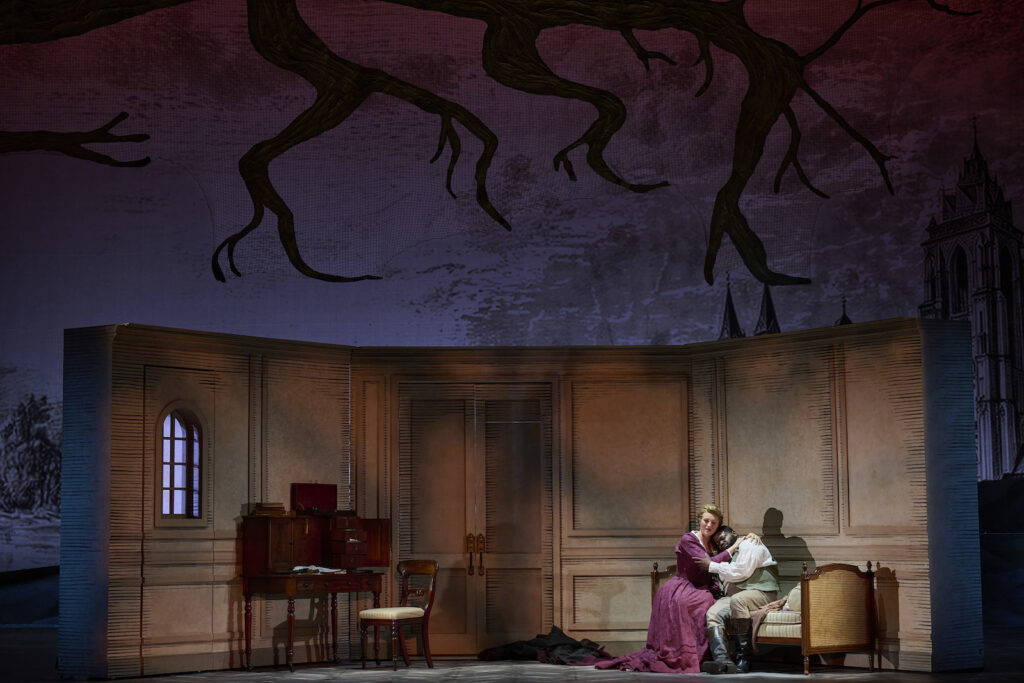
Summoning the author’s enduring spirit to the Four Seasons Centre stage, a colossally upscaled black and white lithograph of Wetzlar Cathedral forming a vaguely ominous, grimly unyielding backdrop, foreground overhung by a menacing tree, the Canadian Opera Company closes its current season with a problematic Werther of notably uneven proportions directed by Alain Gauthier.
Goethe’s namesake hero, a perennially moody poet, as obsessed with the idea of doomed love as he is with the gentle young woman he cannot have, is admittedly ruled by words. Transporting Werther’s stormy, hyper-charged psyche to the opera house with any degree of command is a ticklish proposition.
Massenet’s solution is not so much to confine libretto, but rather to reduce the frenzied scope of Werther’s world to a series of evocative vignettes. Story, starkly segmented by seasoned dramatists Édouard Blau, Paul Milliet and Georges Hartmann, is made to serve the interests of composition. Outbursts of emotion, meticulously crafted, are unapologetically exploited, even more so than usual in Massenet’s operatic canon.
Werther is essentially a number opera, the flow of narrative streaming between the notes, but opera nevertheless, music theatre powered by narrative, fuelled by shared experience on stage and beyond the pit. Nothing can be withheld. Posture and pose, movement and gesture, action and reaction — demonstrable patterns of telling human behaviour all need to be present, curtain rise to blackout.
Regretfully, not all universal terms of operatic reference are always heeded in Gauthier’s approach to Werther. More than often, singers are parked, downstage centre, statue-like and abandoned. Acts I and II are particularly prone to cumbersome direction.
Thankfully, not all is inelegant on stage at the Four Seasons Centre, however.
Act III, the celebrated letter scene — Werther’s beloved Charlotte, racked by agonizing thoughts of what she fears will come to be — is highly effective in its suffocating evocation of anxiety and dread. Act IV shows even greater regard for staging and atmosphere, Werther dying in a lonely little rented room, discarded pistol nearby. Charlotte shattered. Set designer Olivier Landreville conjures a compelling degree of stagecraft as two lives fracture before our eyes.
Singing and playing, by and large, are consistently striking.
Appearing in the title role, dramatic tenor Russell Thomas portrays Massenet’s tortured protagonist in bold, exclamatory strokes, pushing back hard against type. This is not a fragile, psychologically precarious Werther and certainly not the least bit French in tone or articulation. Forceful and muscular, Thomas powers through his frequent on-stage appearances, high notes raging, mid to lower voice strapping and vigorous. Gifted with Massenet’s excruciatingly poignant Act IV showpiece, Pourquoi me réveiller, Thomas impresses rather more than stirs.
Singing Charlotte, Russian mezzo-soprano Victoria Karkacheva crafts a sensitive, richly wrought performance, endowing her character with profound dignity and strength of will. Unfailingly honourable, intensely pious — Charlotte invokes God and/or prayer a total of no less than five times in the course of some seven total stage appearances — Massenet’s moving embodiment of conflicted duty and morality echoes with pathos. Karkacheva strikes straight to the heart, dispatching the composer’s infinitely touching anthem to sadness, Va! Laisse couler mes larmes, with great tenderness.
Bass-baritone Gordon Bintner and soprano Simone Osborne appear as Albert and Sophie, key players in Charlotte’s life — Bintner smouldering and scowly, as Charlotte’s increasingly jealous husband-to-be; Osborne as Charlotte’s sisterly companion, struggling to shield her sibling friend from despair. Fine performances from two thoroughly accomplished Canadian artists, dramatically genuine, vocally vibrant both.
Bass Robert Pomakov sings Charlotte’s father, Le Bailli, a minor Wetzlar civic official and prominent misanthrope. Alain Coulombe and Michael Colvin sing Johann and Schmidt, devoted drinking companions. Emma Pennell and Ben Wallace appear as Käthchen and Brühlmann, a fleeting pair of laconic lovers.
An irresistible troupe of boisterous young singer actors, drawn from the ranks of the Canadian Children’s Opera Company, animate and delight, their bright, cloudless rendering of Noël! Jésus vient de naître — the Christmas carol Charlotte’s father insists his children practice, albeit the height of summer — bookending the opera, bitterly ironic when reprised in the face of death.
The Canadian Opera Company Orchestra, brilliantly led by resident COC Music Director Johannes Debus, plays with towering beauty and grace, Massenet’s endlessly rich, resonant score flooding the FSC with glorious colour and harmony. Preludes and entr’actes are particularly wondrous.
A variable Werther, musically on pitch, dramatically tremulous. A brave, ambitious production, flawed but far from failed.