
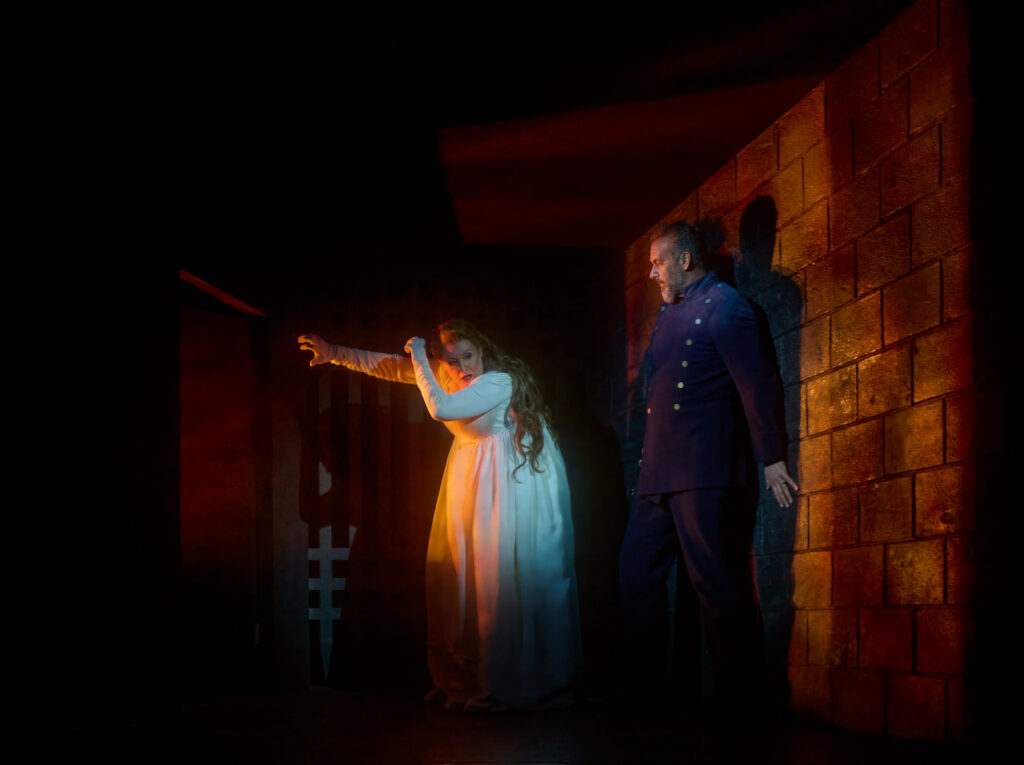

A shadowy nobleman, persistent object of grisly rumours concerning the disappearance of former wives, escorts his latest bridal conquest to his desolate castle where she discovers monstrous scenes of evil lurking behind locked doors.
A woman, frantic, fearful — name unknown, backstory ultimately more intuited than disclosed — discovers a dead body in a treacherous tangled forest, the gruesome remains of the man she was to meet there provoking a tortuous rush of agonizing meditation.
Frequently presented as a horrific enigmatic diptych, composer Béla Bartók’s blood-drenched Bluebeard’s Castle, a roiling one-act opera first staged in 1918, and Arnold Schoenberg’s Erwartung (Expectation), an unsettling expressionistic monodrama of trailblazing proportions premiered in 1924, share notable values, historical and artistic both.
Written in an age of overwhelming disillusionment and trauma in the devastating wake of World War I, Bartók and Schoenberg desperately sought to fashion unique, identifiably 20th century musical idioms of sufficient breadth and depth to express the horror of lived experience in a barren shattered world. The Austro-Hungarian Empire that had once proven so nurturing for the two composers had fractured and collapsed. Romanticism lay limp and dying. A new musical order demanded to be born. Sigmund Freud and Carl Jung would figuratively conduct, their probing psychoanalytical theories of human impulse and action mirrored in surging soundscapes — fraught, feverish, strenuously orchestrated.
Rekindling originating director Robert Lepage’s classic signature piece, Bluebeard’s Castle/Erwartung — debuted in 1993, last presented in 2015 — the Canadian Opera Company hurls us into the darkness of early Modernism with a sharp, still-penetrating double deep dive into the harrowing realm of deviancy and violence, smoldering psychosis and blazing midnight terrors.
Bluebeard’s Castle
The need to unravel Bartók’s knotty operatic saga — libretto by fellow Hungarian, poet Béla Balázs, based, in turn, on a decidedly adult fairy tale by late 17th century French fantasist, Charles Perrault — continues to obsess critics and academics alike to this day. A chronicle of love and devotion won and lost radically compressed in time and place. A mythical expression of universal loneliness and alienation. A window into the depths of the human psyche, the castle’s secret chambers a metaphor for the mind.
Symbol is as commanding as allegory, urgent and multi-faceted here, revival director François Racine leaving us in little doubt that aberrant psychology is the dominant motif shrouding narrative in this prevailing COC iteration.
Crumpled and crushed, sprawled centre stage, exhausted by ceaseless self-confessed disclosures of immorality, Racine’s Bluebeard arouses, if not pathos — there can be neither redemption nor forgiveness for a maniacal serial killer — then something resembling fresh cognizance on our part, a recognition of the character’s growing mental disintegration. Something human, however, vestigial. Something tragic in Bartók’s prideful, fatally flawed anti-hero’s helpless surrender to the dark side of self.
Singing the title role, American bass-baritone Christian Van Horn crafts a Bluebeard of considerable dramatic complexity with an unwavering sense of harmonic equilibrium, tirelessly balancing the role’s polar vocal demands, resounding, rock solid declamation and ferocious emotional expressiveness not infrequently extant within adjoining phrases.
Scottish mezzo-soprano Karen Cargill appears as Bluebeard’s new bride, Judith, pulsating fortissimo top notes bounded by Wagnerian-like chest voice conveying a sense of unyielding fortitude and strength of purpose, albeit doomed, not typically associated with the character. Nem lesz sötet a te várad,/megnyitjuk a falat ketten,/szél bejáarjon, nap besüssöm,/nap besüssön. (“I shall brighten your sad castle,/You and I shall breach these ramparts./Wind shall blow through, light shall enter,/Light shall enter.”)
Seen from the purely orchestral side of the operatic ledger, Bluebeard’s Castle echoes with inventiveness. In 1907, Bartók met the rising star of French sound painting, Claude Debussy, who had arrived in Budapest for a series of piano recitals. Bartók instantly fell under his spell. Combining the freedom and naturalness of Debussy’s Symbolism with the flexible speech-inflected rhythms and scales he had discovered in local folk music, Bartók set Budapest ringing.
Resident Music Director Johannes Debus conducts a sprawling, extended COC Orchestra with unstinting energy and assurance, Bartók’s dark-hued harmonies and crescendi powerfully dispatched.
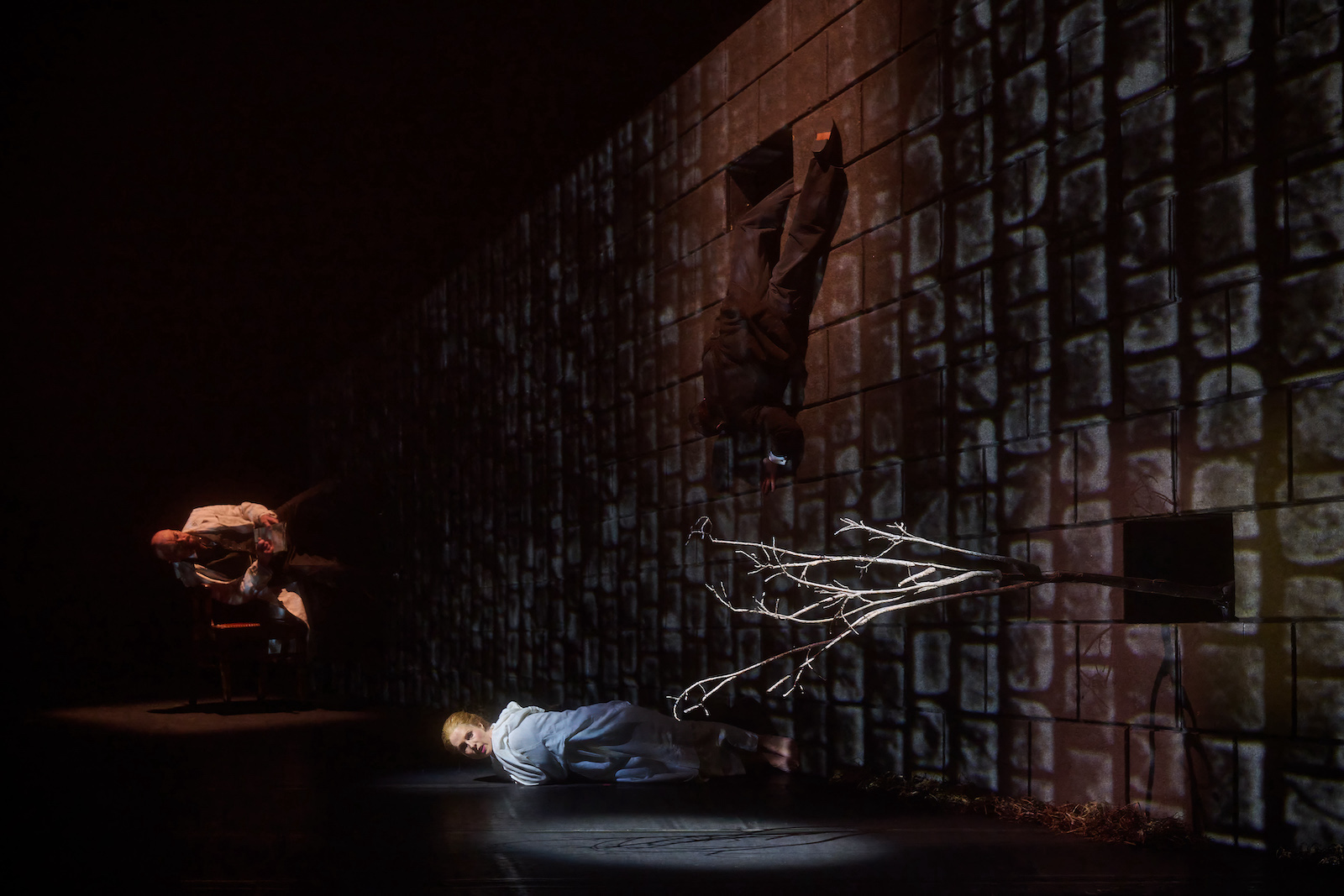
Anna Gabler as The Woman in a scene from the Canadian Opera Company’s production of “Erwartung”, 2026. Photo: Michael Cooper
Erwartung
Based on an actual case study co-authored by Viennese practitioners Josef Breuer and Sigmund Freud, Schoenberg’s crisp, 30-minute psychodrama — libretto by writer/poet/physician Marie Pappenheim — sets the frenzied ramblings of a particularly troubled patient in an altogether original operatic context.
The Woman, Erwartung’s sole principal character and unwavering dramatic focus, exhibits essentially all the classic symptoms of so-called hysteria, a perversely genderized emotional condition commonly diagnosed by invariably male therapists in Schoenberg’s day. Pappenheim and composer were deeply distrustful of the clinical label. The notion of presumed female derangement as an expression of conventional socio-sexual renunciation served numerous agendas, predominately masculine. Depicting The Woman more as anonymous archetype than specific fictionalized individual, Pappenheim scrupulously dissects dramaturgy and scena with near surgical precision to reveal a profound depth of genuine anguish and suffering. Lurking beneath deeply lacerated layers of irrationality, beneath all the ambiguity and narrative volatility of Schoenberg’s tumultuous piece, lies a tangible, tragic, compassionate tale.
Scenic design by Michael Levine, lighting design courtesy Robert Thomson are as stunning as they are emblematic here. Bluebeard’s monumentally dank castle walls, set within a paradoxically glowing gilded Secessionist frame, becomes a vertiginous forest path sprouting a tangle of arms and hands ready to clutch the tortured heroine as she passes. Her naked lover tumbles out in slow motion. A blood red moon hangs in the sky. An attending psychiatrist takes notes, precariously seated on a hard wooden chair turned 90°. The world is askew.
Purportedly written in 17 days — likely more apocryphal than evidential — Schoenberg’s startling, formative atonal score pulses with uninhibited animation, rarely repeating itself. Motifs are fleeting, virtually transparent, rhythmic patterns short-lived. The orchestra, some 100 musicians strong, towers over the tremulous proceedings on stage, essentially a character unto itself, supportive and adversarial in almost equal measure. Debus and players electrify.
Singing the impossibly taxing role of The Woman, Munich-based singer actor Anna Gabler simultaneously shocks and thrills, her pure, infinitely vibrant soprano soaring and impassioned, powerful and poignant. A stunning, triumphant performance of swirling dimensions, heartbreaking and cathartic. And supremely unforgettable.
A double bill of immense impact and authority. Bluebeard’s Castle/Ewartung haunts our deepest, darkest dreams.