
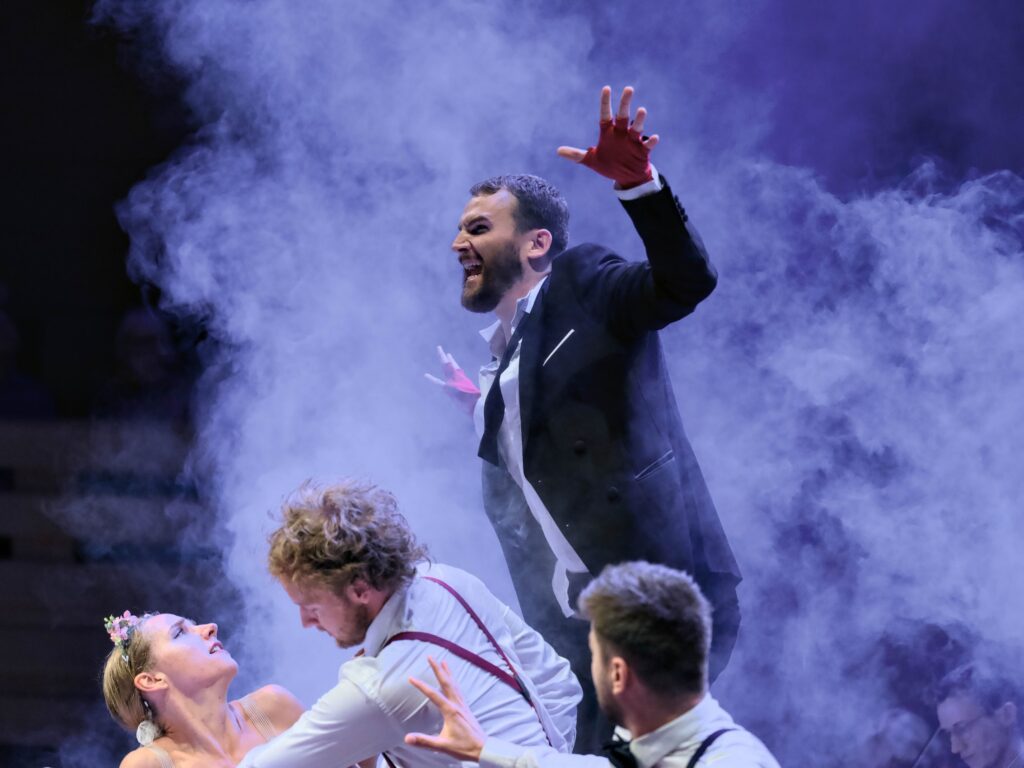

A spirited allegory. The noblest of the Arts — La Musique, La Poésie, La Peinture, L’Architecture — actively personified. The sudden tumultuous intervention of La Discorde, an ever-menacing presence, threatens all that is sublime. Fury and frenzy tear at the fabric of civility. Enter La Paix, beloved of Jupiter, to dispel pandemonium. A joyful air of thankfulness prevails.
A second much older tale. An immortal myth rich in humanity. A fabled musician, daring defier of godly dictates, employs his divinely endowed gift of song to enchant the denizens of the Underworld, rescuing his beloved Euridice, an innocent ill-fated nymph struck down by a savage serpent, from Pluto’s clutches.
Composed in the late 1680s by the unflinchingly inventive master of innovative harmony, Marc-Antoine Charpentier, the two supremely dramatic chamber operas, Les Arts florissants and La Descente d’Orphée aux enfers reference a resonant common motif.
Art and artistry carry with them the matchless power to vanquish chaos and despair.
Summoning the full measure of Charpentier’s abiding power to charm and uplift, Les Arts Florissants, under the direction of acclaimed early opera specialist William Christie, launched the 2026 edition of the Toronto Summer Music Festival at Koerner Hall last week, with an electrifying, high voltage Baroque double bill.
Charpentier on full charge.
Written while in the service of his uniquely independent-minded patron at the time, Marie de Lorraine, Duchesse de Guise, doubtless performed as salon pieces in her Parisian townhouse, Les Arts florissants and La Descente d’Orphée necessitated more than a wisp of ingenuity on the composer’s part to bring them into being.
Modest multi-character ensemble pieces, staged as tableaux, create something of a trompe l’oeil effect here, eliciting the sensation of witnessing much grander undertakings than actually present. Elsewhere, roles are doubled, individual cast members appearing in both Arts florissants and Orphée, not infrequently doubling a third time as choristers within the same work. A strong sense of repertory theatre prevails. Unifying. And economical.
Superbly poised, tirelessly engaged, Christie’s irrepressible young 10-singer actor troupe, partnered by an equal number of exceptional period players, a supple band of dancers adding an extra measure of animation to the proceedings, endlessly captivated.
Set for two violins, two viole de gambe, basse de violon, cello, two flutes, archluth, percussion, harpsichord and organ, the two related pieces hint at more than a passing similarity to the rather more gilded, but surely no more discerning, soirées d’apartements performed during the winter months at Louis XIV’s gleaming Chateau de Versailles, a venue long denied to Charpentier by virtue of Jean-Baptiste Lully’s infamous monopoly as Surintendant de la musique de la Chambre du roi.
Bitter reality aside, however unadorned the mise en scéne, Charpentier’s scores for his strikingly affective idylles en musique, as he preferred to call them, nevertheless bear an unmistakeable air of regal sophistication.
Conducting from the keyboard, Christie and company entranced, stirring and soulful lights up to fade out, co-directors Marie Lambert-Le Bihan and Stéphane Facco, consistently defying expectations, greatly exceeding notions of traditional Baroque performance.
Singers danced. Dancers sang. Musicians acted, violists Myriam Rignol and Mathilde Vialle, delightful, if somewhat displaced to contemporary eyes and ears, as Charpentier-mandated Orphean lyrists caught in the metaphorical spotlight, physically fine-tuned to the swirling proceedings around them.
Stagecraft, admittedly fundamental, as it likely was at the Hôtel Guise where Charpentier lived and worked for some 20 years, proved unexpectedly impactful. A plain white sheet, tautly suspended between two nymphs, yielded no small amount of clever backlit shadow play as L’Architecture’s plan to raise a decidedly precarious human pyramid predictably fell flat. In La Descente d’Orphée, a length of bright red cord, nimbly manipulated, became a frighteningly plausible viper, longer strands of heavier braid, sharply snapped against hardwood flooring, hellish crackling flames.
Pose and posture, movement and dance, mainstays of French opera of the era, all assumed a timeless freeform feel, crisp 21st century Tik Tok-ish moves merging into a whirl of classically balletic revolves, formal 17th century courtly steps flowing into jazzy expressions of palpable emotional vibrancy, choreography by Martin Chaix mixing and mutating past and present with virtually spontaneous abandon, dancers dramatically unconstrained.
Singers radiated much the same qualities.
Camille Chopin enthralled as La Musique in Christie’s boisterous, tumbled rendering of Les Arts florissants; Sarah Fleiss, charmingly lyrical as La Poésie; Bastien Rimondi and Sydney Frodsham attractively paired in a playful duet as La Peinture and L’Architecture. Vocally igniting the piece, Olivier Bergeron sang a rollicking La Discorde, partnering with a rippling chorus of Furies in the irresistibly evil, infectiously syncopated, Sa gloire est un supplice. Josipa Bilić sang an exquisite La Paix, her lovely glowing rendering of Charpentier’s gorgeous air, Parais dans ta beauté première, an all too fleeting moment of great beauty.
Centering La Déscente d’Orphée in a universe of palpable human suffering, Richard Pittsinger essentially defined the title role, his warm, impassioned haut-contre, filled to overflowing with heartbreak and hope, his character’s passage from darkness to salvation reflected in any number of extraordinary solo settings, arguably nowhere more expressive than Orphée’s exquisite Act II aria, Souviens-toi du larcin. Closing the evening’s proceedings, Charpentier’s choir of the damned sang. Vous partez donc, Orphée. Heartbreaking. Tender. Timeless.
A Toronto Summer Music experience long to be cherished.