

With a combined circulation of well over 2 million by the closing decades of the 19th century, Joseph Pulitzer’s New York World and William Randolph Hearst‘s New York Journal, battled for dominance in a crowded, hyper-competitive marketplace. “Yellow journalism”, an oft-quoted label referencing the ubiquitous full colour cartoon character, the “Yellow Kid”, featured in both worker-targeted, penny-a-paper dailies, became standard stylistic protocol for any number of other major media outlets, 72-point plus headline drama the order of the day.
Into this rampantly overinflated, supercharged world of blazing banners and breathlessly related news stepped 23-year old Nellie Bly. A former reporter at the Pittsburgh Dispatch, exasperated by the paper’s reluctance to support her repeated attempts to gain writerly access to the male-dominated bastion of front page relevance, Bly allegedly pitched none other than Pulitzer himself, landing a sensational assignment to report on conditions inside New York’s notorious Women’s Lunatic Asylum on Blackwell’s Island in the East River, feigning madness to gain entree.
Published in 1887 as a searing six-part World exclusive, Nellie Bly’s shattering revelations of monstrous brutality and systemic institutional abuse catapulted her to national attention, shocking readers and civic officialdom alike, ultimately resulting in long overdue scrutiny. Seven years later, Blackwell’s Asylum, as it became widely known, closed.
Nellie Bly, born Elizabeth Jane Cochran, her pen name derived from Nelly Bly, a popular song of the day by Stephen Foster, Pulitzer “stunt girl”, investigator, ambitious newswoman had acquired a new layer of identity, one that would powerfully resonate within her for the duration of her life. Humanitarian.
Evoking the bitterly transformative experience that so deeply affected the venturesome young journalist, Tapestry Opera, in association with the Canadian Opera Company, the Luminato Festival and TO Live, unveiled the latest edition of Opera Philadelphia’s seminal 2023 production, 10 Days in a Madhouse, last week, music composed by Rene Orth, libretto by Hannah Moscovitch.
Employing a substantial degree of reverse narrative engineering, action progressing backwards from Day 10 to Day 1, final moments first, Moscovitch traces a bold linear line through the piece. The impact of the temporal reset is not so much the collapse of any prevailing sense of traditional dramatic build, but rather echoes the lingering air of irrationality and bedlam at play here, explosively expressed, tersely related in carefully inverted structural terms, subverting a good deal of theatrical expectation in the process, ceaselessly throwing us off balance.
Edginess prevailed lights up to black out. Irony bit deep.
Having successfully deceived the eternally officious Dr. Blackwell, earning his prompt diagnosis as clinically mad — woman + disorderliness = female hysteria — Bly finds herself helplessly entangled in an horrific tautology. To be released from forced captivity on Blackwell’s Island, a gender specific dumping ground for the luckless and the dispossessed, requires demonstrable proof of sanity. But to prove oneself sane a patient must behave sanely and to behave sanely is proof positive of an insane patient’s unsound mind.
Bly and Blackwell dance a dangerous two-step, figuratively and literally both. “It soothes women to dance, I find,” Blackwell muses, his insistence that Nellie join him, vaguely suggestive of a propensity for sexual abuse on his part. The not infrequent referencing of waltz as therapy carries with it the distant but ever present ring of perverse subtext. Hopelessness and darkness all but engulf Bly and fellow inmates in endless swells of ill-treatment and calculated clinical disregard.
Escape is an empty fantasy.
“What time’s the boat?” A murmured mantra.
And still the women will not break.
Set designer Andrew Lieberman’s immense circular asylum, more grim blockhouse than hospital, commanded the bulk of the Bluma Appel Theatre’s ample stage geography, an intimidating black tower pierced by several doors all leading to the centre of evil. Threatening and hostile, extended mixed instrumental ensemble perched on top, Lieberman’s hulking visual metaphor consistently chilled. Blackwell’s Island made manifest, all isolation and foreboding, lighting designer Bonnie Beecher’s unforgiving chiaroscuro lighting, as hard-edged as asylum life.
Seen from a purely musical perspective, 10 Days in a Madhouse is decidedly label resistant, Orth’s tumbled, profoundly unpredictable score, a monument to eclecticism. A dynamic, mutable mix of strings, piano, winds, brass and diverse percussion punctuated by bursts of electronica results in a kaleidoscopic array of colour and texture — not dissimilar to the inmates themselves. Pastiche rules supreme, restive melodies swirling and merging one into the other, tremulous, impulsive. Free form jazz, synthetic modes, Blackwell’s sinister waltz, bel canto and romantic phrasing, contemporary pop and atonalism, all twist and twine, diverse strands of harmony vigorously asserting themselves. Conductor Sandra Horst proved nothing less than masterful in her ability to knit Orth’s raveled soundscape together to form something resembling, if not coherence, then certainly resounding orchestral cause.
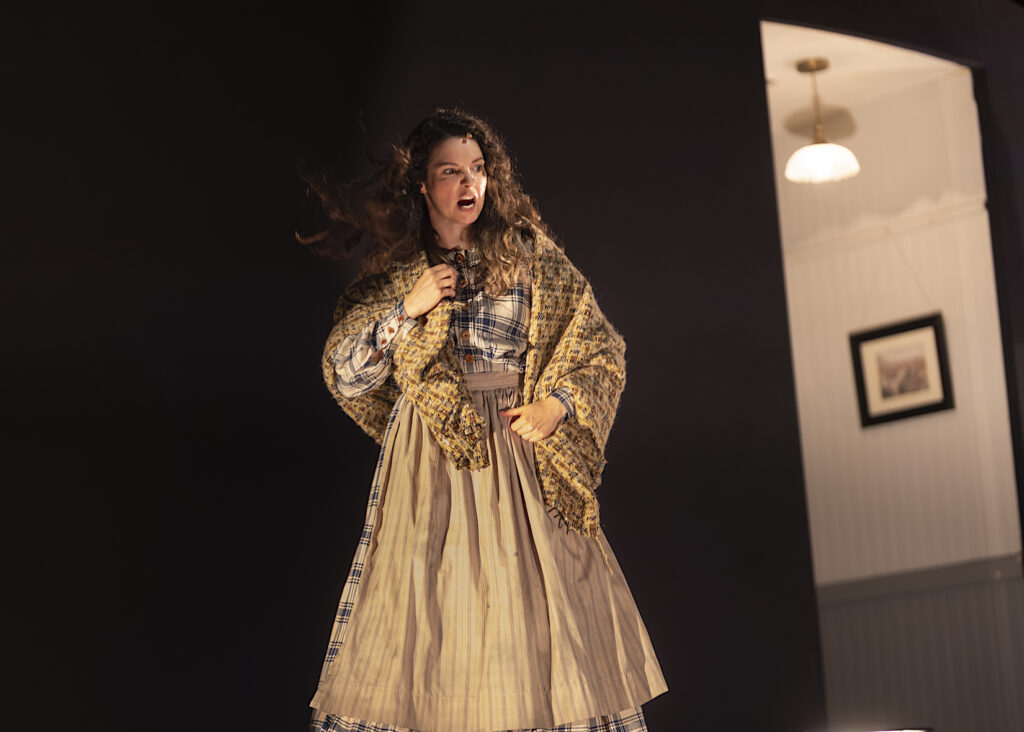
Appearing as Nellie Bly, soprano Mireille Asselin delivered a bravura performance of heroic proportions, repeatedly scaling the dizzy heights of Orth’s punishing tessitura in fine Lucia di Lammermoor fashion, her voice becoming ever warmer and more centred as time rolled backwards, her mastery of pose and posture much in evidence. Opening from a place of high anxiety and fear, Asselin’s Nellie closed in triumph, an indomitable crusader for human rights lecturing from on high, her passage from ingenuousness to desperation compellingly conveyed.
Baritone Jorell Williams sang Dr. Blackwell, stage manners sly and understated, his firm command of parlando, unwavering. In a performance rich in demonstrable authority flashed with smoldering menace, the gifted American singer-actor charmed and alarmed in near equal measure, his rich rolling stylings vibrant and mellow. And dramatically unnerving.
Mezzo-soprano Taylor-Alexis DuPont appeared as Lizzie, inmate friend to Nellie, gifting the proceedings with the evening’s only aria, a glowing, painfully poignant lament, My daughter, she was only four. Voice downsized to a hush, anguish swallowing the limitless stillness of the moment, DuPont tore at the heart, stunningly lyrical, infinitely soulful, her character’s towering grief at losing her child the bitterly ironic cause of her confinement, her shattered reaction misinterpreted as madness. A performance of immense beauty and overwhelming pathos.
Singing to moving communal effect, a spirited ten-woman chorus, asylum dwellers all, greatly expanded the vocal dimensions of Madhouse, arguably nowhere more stirring than in the assembled ensemble’s rebellious delivery of the traditional gospel hymn, When peace like a river. Something of an enforced anthem at Blackwell’s, dispatched here with utterly intentional tone-deaf discordancy, the assembled band of unofficial disruptors seized the stage, segueing to a riotous Go down Moses, the defiant classic spiritual given a supremely appropriate airing.
History rendered timeless. 10 Days in a Madhouse left an indelible impression on the emotions.