

The Robber of Youth. The White Plague. White Death. Consumption.
Tuberculosis, rendered ominously epithetic for the better part of the 19th century, bore with it a decidedly threatening existential aura, a complex set of fraught perspectives born of fear and fascination, grim acceptance and, to the contemporary mind, grossly misapprehended romanticism.
Writing in their groundbreaking 1996 discourse, Opera: Desire Disease Death, University of Toronto inter-disciplinarians Linda Hutcheon, Professor Emeritus of Comparative Literature and husband Dr. Michael Hutcheon, Professor of Medicine, dissect the range of prevailing attitudes to the disease endemic to the age from a broad, scrupulously analytical point of view. “The spiritual yet sexual, sick yet seductive, dying yet desired consumptive heroine” so strikingly embodied by Violetta in Verdi’s soaring La Traviata is presented as one of several multi-dimensional icons by the authors — Les Contes d’Hoffman’s Antonia and La bohème’s Mimi subject to similar scrutiny. Tuberculosis, by far the most prolific terminal disease of the 1800s, is viewed through the twin lenses of hyper drama and rational scientific investigation.
Solemnly associated with specific patterns of preternaturally heightened states of human sensibility — melancholy, nostalgia, thwarted hopes and affections, sensitivity, depression — any verifiable cause and consequence gave way to lore and fetish.
Extreme thinness, a function of the massive weight loss provoked by rampant TB, the shining eyes, pale translucent skin, glowing red cheeks, all occupied a place of compulsive eroticism.
“When a society does not understand — and cannot control a disease,” the Hutcheons remind us, “the ground seems to open up for mythologizing or mystifying it.”
With a taut, irrepressible revival of its by now classic, period-informed La Traviata, the Canadian Opera Company launches its 20th Anniversary Season at the perennially splendid Four Seasons Centre on a lingering high note, historically resonant, sweepingly affecting. First staged in Toronto in 2015, revisited in 2022, the venerable co-production partnered by Lyric Opera of Chicago and Houston Grand Opera originated by director Arin Arbus continues to yield a profoundly robust measure of compelling emotion.
Set at the time of its premiere in 1853, revival director Mo Zhou brings Arbus’s time-tested vision of shattering pathos and crushing human hypocrisy into sharp, unwavering focus. Violetta Valéry, one of any number of elite sex workers who dwelt at the heart of Parisian wealth and power during the Second Empire, consistently occupies the spotlight, Verdi/Piave’s clear-eyed depiction of sophistication and glamour for hire reflecting a generalized laissez-faire attitude to prostitution at the upper levels of mid 19th century French society. A newly upwardly mobile bourgeoisie, dotted with faded aristocratic enablers, party and posture with near equal fervour. Moral guardianship is a shaky proposition.
Based on a popular novel of the day, La Dame aux camélias by Alexandre Dumas fils — later recast by the author as a no less successful play — La Traviata’s doomed heroine, Violetta, closely mirrors Dumas’ Marguerite, herself a reflection of his real-life mistress, Marie Duplessis, an authentic, much heralded courtesan of the time. Her death from TB at the age of 23 dominated Parisian front pages for days, an emblem of a precarious, grotesquely gendered existence laid low by remorseless fate. Little wonder that Verdi, eternal humanitarian, liberal idealist, unyielding social critic should be so drawn to the palpable authenticity of Dumas’ stormy roman à clef.
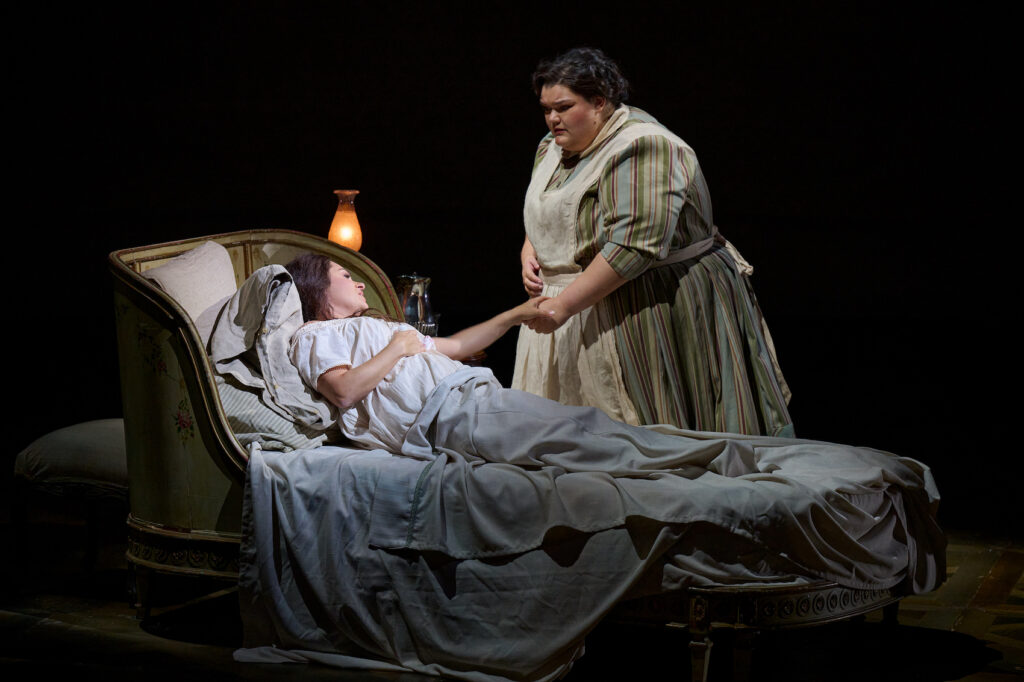
Appearing in the impossibly taxing, SuperSoprano role, rising Metropolitan Opera headliner Kathryn Lewek gifts this pulsing, vintage Arbus iteration with a freshness of style and acuity of stage manners born of exceptional insight. A Violetta of unique dimension, vibrantly inhabited, gorgeously sung.
Every soprano who undertakes Violetta is essentially triple-cast as three different singers — a coloratura soloist, a lyric specialist and a spinto/dramatic artist often called on to perform together in a single scene. Confronted by a series of daunting Act I hurdles virtually at curtain rise, cued by a series of sensational runs during Alfredo’s Un di felice (“One day, happy and airy”), followed by a fretful recit, È strano! (“How strange it is”), vaulting to the showstopping, Ah, fors’è lui (“Ah, perhaps he is the one”), Lewek immensely impresses.
Head spinning, tipsy and unbalanced, champagne bottle in hand, this Violetta is a picture of dizzy confusion. Ambushed by feelings of love long denied to herself, excited by what may come to be, giddy and disoriented, Lewek’s battered consumptive courtesan does her best to shake herself free from idle dreams, wrapping her breezy call to arms, Sempre libera (“Forever free”) around her, the comforting sentiment suddenly sounding strangely implausible. Alfredo, the guileless young country boy from Provence, has breached her defences.
Lewek is triumphant, her voice unquestionably glorious, supple and silky and strong. But it is in quieter moments, Violetta’s vulnerability centre stage, that the venturesome American singer actor arguably shines brightest, her gleaming, golden head voice downsized to anguished pianissimo. Cosi alla misera, ch’è un di caduta,/di più risorger speranza è muta. (“Hope of salvation is not given to one who has fallen”). Tears flow. Lewek rules our hearts.
Returning Chinese tenor Long Long, last seen at the FSC in the title role in Gounod’s Faust, sings an unexpectedly paradoxical Alfredo Germont, his rather stiff pose and posture and tempestuous dynamism oddly intermingled. A blunt, rebellious Alfredo, impassive and defiant, Long’s ringing, Italianate-tinted timbre feels somewhat overstated. Credit due, however, his character ultimately springs to life with a looser, more actorly approach to action and reaction in Act III.
Baritone Russell Braun appears as Giorgio Germont, a role of some considerable depth and psycho-social complexity. Obsessed by, one suspects, a considerably more exaggerated self-imposed imperative to preserve family honour than compelled by circumstance, Alfredo’s supremely tyrannical father bullies and cajoles his way to victory, forcing a brutal sacrifice from both his son and the woman who adores him. It is only much later, as Violetta lies dying, shunned and abused, Alfredo shattered and self-destructing in the background, that he comes face to face to face with the tragedy he has precipitated. Di più non lacerami,/Troppo rimorso l’alma mi divora (“Say no more, don’t torture me/Too much remorse seizes my soul”). Rich and rolling, Braun’s voice rises and falls on waves of gravitas. Verdi’s impassioned salute to ancestral roots, Di Provenza il mar (“The sea and soil of Provence”) is given a welcome sunny airing.
Bass-baritone Nick Murphy and tenor Owen McCausland sing debauched nobles, the Marquis d’Obigny and Gastone, Viscount de Letorières respectively. Baritone Peter Barrett is the volatile predator, Baron Douphol. Mezzo-soprano Ariana Maubach is Violetta’s chirpy, social-climbing friend, Flora. Soprano Emma Pennell is Violetta’s devoted, caring maid, Annina.
The Canadian Opera Company Chorus, some two dozen plus voices strong, populate a succession of drunken bacchanals, a boisterous swirling throng of utterly implacable hedonists and insatiable hangers-on, increasingly uproarious, high-spirited and uncontrollable and somehow vaguely sinister.
Visiting Zurich-based Italian conductor Paolo Carignani leads a spectacularly vibrant Canadian Opera Company Orchestra with great style and flair, Verdi’s wondrously liquid score flooding the FSC with a fathomless depth of colour and harmony.
La Traviata is very much a product of the maestro’s middle period, his anni di galera (“galley slave years”), a time of great invention and reassessment, a moving forward from older, more formalized bel canto modes to looser, less predictable Romantic settings, though traditional cavatinas and cabalettas still adhere. Carignani and players voice the entirety of Verdi’s towering soundscape with great gusto and meticulous care, the mighty Brindisi, opera’s penultimate drinking song, is unleashed to resounding explosive effect, prompting the first of many uproarious bursts of opening night applause.
A contagious La Traviata. There can be no resistance.