
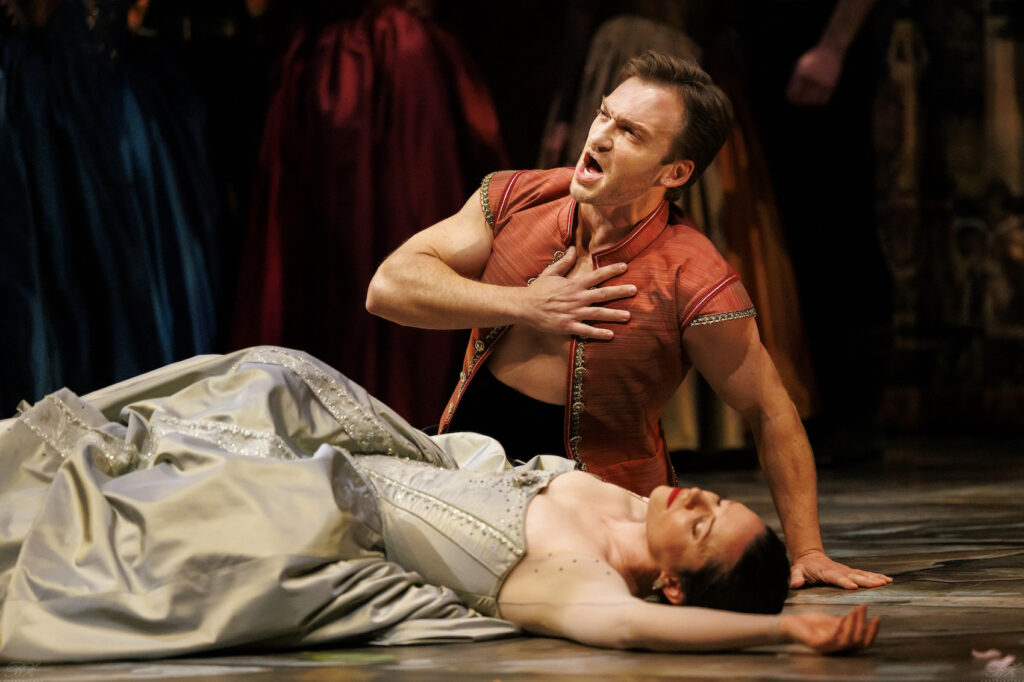

A venomous viper strikes. A gentle nymph falls prey. Horrified companions. Eurydice collapsed and lifeless. Orpheus paralyzed with despair. The music rests. Stillness as deep as grief. An eternity of silence.
Explosively directed by Marshall Pynkoski, stirringly choreographed by Jeannette Lajeunesse Zingg, Opera Atelier graced the unexpectedly repurposed Koerner Hall stage last week with a supremely vibrant presentation of Marc-Antoine Charpentier’s late Baroque masterpiece, The Descent of Orpheus (La descente d’Orphée aux enfers), exquisitely detailed, boundlessly expressive, production design, singing, dancing and music nothing less than glorious.
Set aloft on four towering columns, each bearing a colossal painted tondo — a fierce 3-headed Cerberus; a menacing coiled serpent; a ubiquitous lyre; an illicit pomegranate — resident set designer Gerard Gauci literally raised the array of mythological imagery and emblem on show to dramatic heights, faux Aubusson tapestries draped from on high. An air of theatrical adventurism overhung the hall, a newly introduced catwalk extending the principal playing area into the audience framing a surprisingly active ersatz orchestra pit in the process. A monumental double staircase rose Olympus-like upstage.
This was an operatic undertaking of some considerable grandeur, original 17th century antecedents notwithstanding.
Written circa 1686 — verifiable details concerning Charpentier’s crisp 2-act sensation are in notable short supply — The Descent of Orpheus is widely thought to have been created as a salon piece by the then 43-year old composer while in the service of his eminently discriminating patron at the time, Marie de Lorraine, Duchesse de Guise. That the work should have found its way to Versailles via her Parisian townhouse in the heart of the Marais during Charpentier’s lifetime is as tantalizing a prospect as it is historically contentious. Artistic entrée to Louis XIV’s fabled chateau had long been officially denied to Charpentier by virtue of Jean-Baptiste Lully’s infamous monopoly on all things operatic as Surintendant de la musique de la Chambre du roi. That said, the referencing of Apollo, the Sun King’s self-branded alter ego, rather bluntly hints at a potential courtly connection — or hopeful ambition — in the early phases of The Descent of Orpheus’ evolution from pen to venue.
Pynkoski clearly relishes the suggestion, staging the piece with lavish, unapologetic extravagance, chamber opera rendered regal, tragédie lyrique in all but gilded name. Speculation surrounding the absence of a customary third act — questionable proof of an abandoned final draft or simply lost text — is supplanted by an open-hearted acceptance of Descent as an extant, through-composed organic whole. The dramatic flow sweeping over the evening, the overwhelming humaneness, deeply moved. This, TO’s most recent telling of Ovid’s timeless tale, a sweeping saga of death defied, proved intimate and expansive in virtually equal measure.
A father and son reconnect. A tender kiss melts a tyrant’s heart. A loving couple, cruelly parted, reunites in each other’s arms. Every precious moment felt fully illuminated. Dancers swirled and soared, chaconnes, passacaglias, a stately saraband bending and flexing the sweeping, overarching narrative arc.
Appearing as Orpheus, American tenor Daniel McGrew gifted the evening with a singularly triumphant performance, his lofty, ringing haut-contre mirroring all the trauma and emotional desolation, all the resounding beauty of Charpentier’s magnificent score. McGrew is an artist of consummate singer actor ability with compelling, infinitely expressive stage manners — urgent, charismatic, intensely authentic. His gorgeous interpretation of the opera’s arguably most lyrical air, Souviens-toi du larcin, flew straight to the heart.
Mireille Asselin appeared as Eurydice, a role expressed primarily in terms of pose and posture, manner and movement, Charpentier granting the character little in the way of vocal opportunities to shine. Asselin fulfilled the assignment with great charm and poise.
Sopranos Sinead White, Cynthia Akemi Smithers and Karine White, joined by mezzo-soprano Mireille Lebel populated a lively nymphean ensemble in Act I, delightfully animating Orpheus and Eurydice’s fleetingly idyllic wedding celebration, voices bright and clear as cloudless summer skies. Innocence personified.
Baritone Olivier Bergeron sang a warm, loving Apollo, a rich-voiced paternal presence on stage all too willing to share Orpheus’ anguish. J’entre dans ta douleur, ton tourment est le mien.
Singing a magnificently grotesque trio of sinful miscreants, baritone Christopher Dunham, tenor Alexander Cappellazzo and the tireless Bergeron, featured in a second role, launched Act II on roiling notes of endless suffering accented with helplessness. Strapped to monstrous wheels; Tantalus, blasphemer of gods; Ixion, patricidal brute; Tityos, rapacious giant — each in turn related his hellish sentence, cycle on cycles of ghastly torment uniting them in tumultuous appeals for mercy.
Soprano Lebel doubled as Persephone, Queen of the Underworld, a compassionate, abundantly benevolent goddess drawn to Orpheus’ plight, a regulator of the natural order, voicing the part with great solicitude and benevolence.
Baritone David Witczak sang a complex, commanding Pluto, muscular and robust. Ruler of darkness, sovereign of death. Confounded and confused by Orpheus’ plea for resurrection on behalf of his beloved, the mighty god wavers and softens. A perceptive portrayal by the gifted French-born soloist underpinned by a strong sense of abiding physicality.
Raising the curtain on the evening’s proceedings, soprano Measha Brueggergosman-Lee sang a gleaming setting of Ralph Vaughan Williams’ Orpheus with his Lyre courtesy music director/conductor Christopher Bagan, his employment of 17th century-style viola da gambas as surrogate harp subtly reflective of Charpentier’s Baroque-approved instrumentation in Descent.
Lights up to fade out, musicianship was superb, Maestro Bagan leading from the harpsichord with great assurance and artistry, compact 8-player period orchestra drawn from the ranks of Tafelmusik, unceasingly nimble and resonant.
An uplifting Descent of Orpheus of immense humanity and refinement.